
Why Your Moodle Catalog Might Be Scaring Users Away
In the age of streaming services like Netflix and Spotify, we have become accustomed to hyper-personalized experiences. When we log in, we don’t just see a database of movies; we see a curated list titled “Because you watched…” This level of personalization has set a standard for user experience (UX) across all digital platforms.
However, when employees or students log into a Learning Management System (LMS) like Moodle, they often step back in time. They are greeted with a complex tree of categories: Site Home > Learning > Department > Year > Semester > Course.
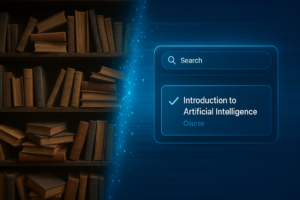
This phenomenon is known as the Paradox of Choice, or in the eLearning world, “Search Fatigue.” When faced with a massive catalog of hundreds or thousands of courses, the cognitive load required to find a relevant learning path is so high that many users simply give up. They log out, or worse, they enrol in the first course they see just to tick a box, resulting in low engagement and poor knowledge retention.
The Hidden Cost of a Cluttered Catalog
For Learning & Development (L&D) teams and University Administrators, a large course catalog is a badge of honor. It signifies a wealth of knowledge. But for the user, it is a labyrinth. The costs of this disconnect are tangible:
-
Low Discovery Rate: Excellent courses, developed with significant budget and time, remain “hidden” simply because they don’t contain the exact keyword a user types into the search bar.
-
Decision Paralysis: Psychological studies show that when presented with too many options, humans tend to choose none. In an LMS context, this means lower voluntary enrolment rates.
-
Administrative Burden: L&D teams are flooded with repetitive emails: “What course should I take for leadership?” or “Where can I find the Excel training?”
From “Search” to “Recommendation”: The AI Shift
The solution lies in shifting the paradigm from active searching to intelligent recommendation. Standard Moodle search engines rely on Full-Text Search. If a user searches for “Sales,” the system looks for that exact word. It misses courses titled “Negotiation Tactics” or “Client Persuasion” because the keyword doesn’t match, even though the intent does.
This is where the AI Course Recommendation Plugin changes the game. By utilizing advanced Natural Language Processing (NLP), the plugin understands the intent behind a query, not just the syntax.
How Our AI Course Recommendation Plugin Works
Imagine an LMS that acts as a knowledgeable mentor rather than a database. Here is the workflow our plugin introduces to your Moodle environment:
-
The Conversational Prompt: Instead of using filters, the user types a natural sentence into a modern Chat UI: “I feel overwhelmed at work and need to manage my time better.”
-
AI Analysis: The engine—flexible enough to use either OpenAI or DeepSeek—analyzes the sentiment and the semantic meaning of “overwhelmed” and “time management.”
-
Hybrid Retrieval: The system scans your entire catalog using a combination of vector embeddings (context) and full-text search (precision) to find the best matches.
-
The Result: In under 5 seconds, the user is presented with the Top 5 most relevant courses. Crucially, the AI provides a reason for the recommendation, such as: “This course is recommended because it covers prioritization techniques helping with stress management.”
-
Immediate Action: A direct “Enrol” button allows the user to self-enrol immediately, following all standard Moodle security protocols.
Why Speed Matters: The 5-Second Rule
In modern UX, speed is trust. If a search takes minutes of scrolling, you lose the user. Our plugin is engineered for high performance. By using incremental indexing and smart caching, the AI creates embeddings of your courses in batches. This means that even with thousands of courses, the recommendation engine is lightning fast.
Conclusion: Turn Your LMS into an Assistant
Your LMS should not be a warehouse where courses go to gather dust. It should be an active participant in your users’ growth. By integrating the AI Course Recommendation plugin, you are not just adding a feature; you are removing the friction between your learners and the knowledge they need.
Stop letting search fatigue kill your engagement stats. Transform your Moodle site into an intelligent learning assistant today.